Tuesday, January 30, 2018

Olympian efforts to make Jamaica a place of safety

Observer column for MON 22 JAN 2018
by Jean Lowrie-Chin

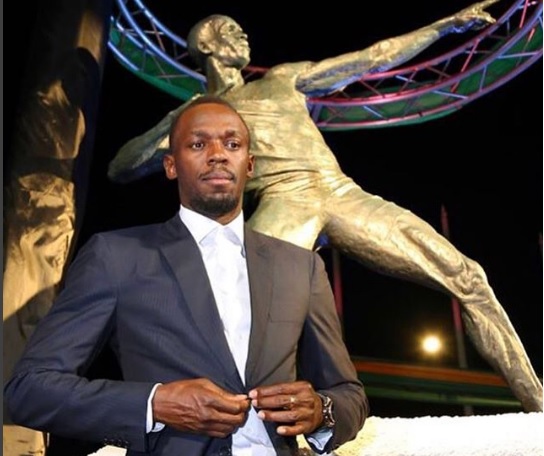
The generous  Jamaican Olympic Legend Usain Bolt committed J$1 million to the
rebuilding of Walker's Place of Safety

I can write volumes about our experience thirty years ago with a so-called ‘place of safety’ for children. We had decided to adopt a second child and were told that we could visit the baby boy who was being kept at a ‘place of safety’ until our home could be passed for his relocation as the first step of the process.

We fell in love with the sweet four-week-old, and were concerned that he was so congested and that he was not being changed often enough.  We were permitted to take him to the doctor and filled his prescription.  We brought the medicine, diapers and other items to ensure that he was well supplied.
You can imagine our distress when we discovered by the next day that all the items including the medicine had been stolen.  We had to visit more frequently to give him his regular dosage and change him ourselves.

The facility was a disgrace – we learned to jump up the steps quickly because they were crawling with insects at night.  We were relieved when we could finally take our baby home, so sick that over the next three months he had to be on several courses of antibiotics.

We felt sorry for the manager of the home, a nurse who seemed frustrated in her efforts to manage the staff. Within that year, perhaps due to our and other complaints, that so-called ‘place of safety’, located on the lower end of Lady Musgrave Road was closed.

For us, the story has a happy ending, as our son Noel, now a protective six-footer and a manager in our business, is looking forward to the celebration of his 30th birthday this week.

For Anna Kay Moreland and Anika McCrea, who perished in the fire at the Walker’s Place of Safety last week, their story had the most tragic of endings.  The wringing of hands reminds us of what followed the fire at the Armadale Correctional Centre in 2009 which took the lives of seven teenaged girls.
We are not judging the staff at Walker’s Place of Safety, because we understand that some of these institutions can barely make ends meet with the resources they have.  However, we must judge ourselves who call ourselves leaders in this country.  Whether we are members of the private or public sector, we have to become more committed and passionate about the well-being of our fellow Jamaicans, particularly the most vulnerable of our citizens.

Too little is being done and too slowly – it is up to us to push the envelope on child safety. The donations are important, but these should be followed up with urgent action.  The victims of the Armadale fire had to wait seven long years before damages were awarded. 

‘we are at war with ourselves’

If we do not look to the protection of our children, whether in institutions, at home, in school or on the street, we will never be able to solve Jamaica’s crime problem. If children are ill-treated, we cannot expect humane behaviour from them when they become adults.

In his stirring message at last week’s National Leadership Prayer Breakfast, Rev. Astor Carlyle noted: “Warm and generous are the words our visitors use to describe us, but the homicide figures show that we are at war with ourselves.”

He challenged Jamaicans to move out of their self-serving comfort zones: “when institutions and office bearers of healing and accompaniment misappropriate the trust vested in us to satisfy our selfish lust, then we are a people at odds with ourselves indeed .. a daunting side of the Jamaican reality”.

Since the start of the year, we see the result of our inactivity and insensitivity as we have lost count of the number of murders committed. We support the state of emergency in Montego Bay, but we know it did not have to come to this – too many wrongdoers have hypocritical supporters in high places.  No state of emergency will have long term results if the thug-hugging does not stop.

Step up with sports


Legendary Veronica Campbell-Brown
receives Icon Award from Gleaner
Manabing Director Chris Barnes 
Special Olympian Dave Oddman
receives Award from
Wisynco's Francois Chalifour
Special Olympian Romaine
Austin receives his Award


Jamaica cannot be prouder of our National Sportswoman and Sportsman of the Year, Alia Atkinson and Omar McLeod. At last Friday’s RJR-Gleaner National Sports Awards, they both spoke passionately about perseverance and hard work, faith and the ability to handle failure. McLeod noted that our sports stars were so outstanding that one had to be an international champion to win the Jamaican honour. 

We heartily applauded Veronica Campbell-Brown for receiving the Iconic Award, moved by the tears of this humble but determined warrior of athletics who has earned more medals than even the great Usain Bolt.  We also noted the patriotic dedication of Don Anderson, recipient of the Chairman’s Award, who was Jamaica’s Olympic Chef de Mission for six consecutive Olympic Games.

We applauded loudly for Special Olympian gold medallists Dave Oddman and Romaine Austin, both speed skaters on ice, awarded for their outstanding performances in the 2017 Special Olympics World Winter Games, held in Austria. Austin’s gold was the first ever for a Jamaican performing on ice, related Lorna Bell, untiring Special Olympics Jamaica Executive Director.

Sports for Peace

How then, can we infuse these great qualities to heal our wounded nation? There may be a solution staring us in our faces, as so brilliantly outlined by GraceKennedy CEO Senator Don Wehby. He referred to the Sports section of Jamaica’s Vision 2030, outlining a dynamic national plan for sports, including ‘sports for peace’. This ‘Sports for Peace’ had us sitting up and listening keenly.   

Don Wehby receives a gift of appreciation from
RJR-Gleaner Group Senior Executive Yvonne Wilks O'Grady
“The United Nations recognizes the practice of sport as an instrument for promoting peace,” said Senator Wehby, “and for playing a significant role as a promoter of social integration and economic development. I strongly believe that sports can play a larger role in Jamaica’s fight against crime.”

He made the following points:  
“It has an ability to unify people in a way that is unbelievable.  When you look at the crowd that gathers in Half Way Tree when Jamaica is about to perform on the World stage.  Every man woman and child is out there some with their pot covers and all are dressed in their Jamaican colours united to cheer on their champions .. One Jamaica –united with love and passion.

“It serves as a positive outlet for the youth providing a channel for expression, building friendships and can deter risky behavior. It shows what can be achieved through hard work, determination, self-belief and fair play. 

“It facilitates social development in under-resourced communities. There are so many community sports clubs around Jamaica with opportunities to nurture the interest of the youth and for harnessing talent.  These clubs need visionary partners and financial support in order to become sustainable sources of social reform in their respective communities.  Public-Private partnerships can work when we begin to see these associations as viable business opportunities.”

The power of sports will have North and South Korea marching under one flag for the Winter Olympics – what a message for this tiny country Jamaica.  Let’s get serious about sports for peace.


Lester Woolery - The Renaissance Man

Tribute to the late Lester Woolery, The Renaissance Man 


Updated from Jamaica Observer column of September 2008
By Jean Lowrie-Chin

There are such tired old clichés about our civil servants, that I am always glad to celebrate the excellent individuals who choose to remain in the service because of the passion for their country.  Indeed, my late friend Lester Woolery was a renaissance man, weaving scientific terms and Virgil in riveting conversations, creating rate hybrids of roses, and making himself accessible to every friend in need.

A former director of pharmaceutical services in the Ministry of Health, Lester became the man who could source any drug from anywhere in the world.  Lester left no stone unturned to find hard-to-get prescriptions for Prime Ministers, Ambassadors and ordinary joes. You see, Lester was as passionate about people as he was about his profession. He earned the respect of friends from the British Universities he attended in the 50’s, and colleague consultants at PAHO, WHO, USAID AND UNDP.

In a tribute to Lester, his former student and colleague, Permanent Secretary for Health, the late Dr. Grace Allen-Young described his thoroughness, approachability and astounding knowledge of pharmacy.

Having worked in the efficient Canadian system with the head of that country’s FDA, Lester believed that there needs to be a reduction in Jamaica’s bureaucracy.  The Canadian system assumes that everyone is honest, and if they are found to be otherwise, the full force of the law is brought to bear against them. Lester Woolery believed that the job of the public servant is to assist commerce and to work in tandem with the private sector, not to put obstacles in their way.

After retiring from the civil service in the 90’s, Lester Woolery carefully examined the many offers he had from various companies.  The then small company Lasco, appealed to his pioneering spirit and he opened doors for most of the low-cost medications that bear their name.  Lester’s approach?  He transfixes associates with his humour and brilliance, and his awareness of cultures around the world.  He shared much appreciated books on Jamaica’s art and plants with Dr. Lulla, the head of the powerful Cipla pharmaceutical company of India.

As a humble St. James school boy, Lester Woolery won a sought-after parish scholarship for Cornwall College and later copped the “Eighty Pound Scholarship” for vocational training.  At Cornwall College, two years after him the winner of a similar scholarship was his lifelong friend, the late Professor Rex Nettleford.

Lester was a popular pharmaceutical agent for GraceKennedy who awarded him an Independence Scholarship to study Pharmacy at the University of London.  While there, he gained a further scholarship for the Masters in Pharmacy at the University College Hospital, where he studied at the feet of its famed Head of Pharmacy, Douglas Whittet.

“Those of us who won this type of scholarship had a sense of devotion and gratitude to our country,” reflected Lester. “In the Health Ministry we had a deep sense of concern for the sick, and our decisions were centred on this.”

Lester Woolery’s philosophy of substance over form and goodwill to all, whatever their political persuasion, was one that should inspire all members of government, including those in the new Opposition.

Lester was sought after at any gathering: you could not sit with him at a dinner party and not learn something new.  Here are a couple of his gems: If you want to cure the burn of hot pepper, simple rinse with a few drops of hydrogen peroxide in a cup of water.  I tried this remedy and it worked almost instantly.  In your garden, if a fruit tree refuses to bear, bury a dead animal at its root.  Lester says this is an old Chinese practice.

Lester Woolery’s farm, Skyview, near the Blue Mountains, was home to some to some of the most exquisite hybrids of roses and rare birds.  He described himself as a flower friend to late prime minister, Michael Manley with whom he shared his special knowledge on horticulture, and whose farm was almost next door.  “Michael Manley instructed that only roses from his farm and mine should be used at his funeral,” Lester recalled. “And so it was.”

We marvelled at Lester’s youthfulness and attributed it to his sense of humour and his constant engagement with people and with nature.  He certainly kept the “civil” in his service to country, and we looked forward to hearing his tips on call in radio programmes, for which he attracted quite a following.  He was also a lecturer at UWI and the Kingston School of Nursing, Lester was a keen family man.  

A citation which I was proud to prepare for him read: “The excellence with which he has blazed through life has left a path so bright, and it is no wonder his children have all followed it.  A devoted father, it is to his eternal pride that he can view the accomplishments of each of his six children, who have established themselves as competent practitioners in the areas of medicine and business, and promising students in the fields of science and law.  He is a caring and witty husband to his lovely wife, Linda.”

Rest in Peace, my friend Lester!

Monday, January 29, 2018

Janice Budd - in God's garden

Below are Gerry McDaniel's reflections on the excellence and faith of Janice Budd, the late award-winning Jamaican journalist. 

*_From a Budd she grew to a  blooming flower in God's beautiful  garden_*

Yesterday I joined my media colleagues inside the Swallowfield Chapel in Kingston to say goodbye to an exceptional human being. 

In death, as in life, Janice Marjorie Budd was a uniting force in a divisive world. For two intense hours, there was no evidence of the typical bravado and egotistical vibe that characterizes most media gatherings. 

Inside that Chapel, we were all united by the stark realities of our shared humanity. We wept, we chuckled, laughed out loud...the mood moved through solidarity, sorrow, anger at the thief of cancer, introspection and personal accountability...to hope for life everlasting. 

The experience was at once emotionally draining and liberating. 

It was *church* in the most redemptive and restorative sense. 

By its difference, it was a clear reminder of why I tend to dislike funeral. THIS was not your garden variety sad-fest. It was a rich send off for a sister sold out to Christ in her demonstrated conviction.

It was dignified and devoid of bling, drama and national hype. It was intimate, serene and sincere. 

No distraction of a body in the sanctuary, it was a celebration of the indestructability of the soul that dies in Christ. 

The lead text summarizes the context beautifully.

_1 Thessalonians 4: 13. Brothers and sisters, we do not want you to be uninformed about those who sleep in death, so that you do not grieve like the rest of mankind, who have no hope. 14. For we believe that Jesus died and rose again, and so we believe that God will bring with Jesus those who have fallen asleep in him. 15. According to the Lord's word, we tell you that we who are still alive, who are left until the coming of the Lord, will certainly not precede those who have fallen asleep. 16. For the Lord himself will come down from heaven, with a loud command, with the voice of the archangel and with the trumpet call of God, and the dead in Christ will rise first. 17. After that, we who are still alive and are left will be caught up together with them in the clouds to meet the Lord in the air. And so we will be with the Lord forever. 18. Therefore encourage one another with these words.

Encouraging it was too.
Extremely encouraging. 
... And yes, challenging. 

 I was personally challenged to step out of the way while God works his wonders. In less than 50 years, Janice Budd demonstrated what a life well lived looks like. She used her talent for good.she pursued work that truly mattered in the long haul from the the hilltop home of the Jippy-jappa - Westwood - to the world of media, cutting through public and private sectors, with brief stops in Corporate. 

Through it all she was obsessed with quality, imbued with an engaging smile and a calm and beautiful spirit. 

#JustJahWorks

The road less traveled, the narrow door. She chose to abandon the default position of bullyism that marks the practice of so many journalists to adding value to our understanding of this complex little space that we share. 

In his homily, Pastor David Henry tagged one of Jan's favourite expressions, "all for God's glory".

As her brother Trevor mentioned in the eulogy, even in what could have been the depths of depression over her deteriorating condition, when asked if she questioned God about the situation. She took the high road, saying, "No enuh, I am just listening to what God is trying to teach me."

So the message was entitled... 

*Finishing strong... All for God's glory.*

In a concise and pointed message, Pastor Henry touched many sensitive points but I will share my favourite two. 

*Man cannot fix the mess we're in*
Pastor Henry who is also an attorney at law was recently tapped to be part of a team to look into the execution of the State of Emergency currently in force in sections of St. James. 

While he will apply himself prayerfully and dutifully to that assignment he reminded in no uncertain terms that none of this mess... This national crisis of runaway murders can be fixed by external measures. He then dropped a gem for all times. 

*_The only foolproof Crime Plan is to love God  and love your neighbour as yourself_*

Not surprisingly, when I shared that through social media, the skeptics came out in full attack mode. One sarcastically wanted to know if that was like praying and waiting... 

You know what the scriptures say about the message of the cross to those who have not yet surrendered... It makes no sense. (Ref. 1 Corinthians 1:18)

At the core of the brilliance of this statement by the good pastor was the message of reconciliation. It is as incomprehensible as it is revolutionary. 

Romans 5: 8. But God demonstrates his own love for us in this: While we were still sinners, Christ died for us. 9. Since we have now been justified by his blood, how much more shall we be saved from God's wrath through him! 10. For if, while we were God's enemies, we were reconciled to him through the death of his Son, how much more, having been reconciled, shall we be saved through his life! 11. Not only is this so, but we also boast in God through our Lord Jesus Christ, through whom we have now received reconciliation.

The other point that resonated with me powerfully was this:

*True commitment to Christ by the standards of the world requires a 'scandalous exclusivity:*
.....
The battle is not ours. We sow in faith and God will bless. His word never returns without some effect. 

_Isaiah 55: 10. As the rain and the snow come down from heaven, and do not return to it without watering the earth and making it bud and flourish, so that it yields seed for the sower and bread for the eater, 11. so is my word that goes out from my mouth: It will not return to me empty, but will accomplish what I desire and achieve the purpose for which I sent it.

From yesterday's whirlwind of emotions and introspection God has graciously granted me a quiet sense of peace and hope this morning, even as I feel the gap of Janice's physical absence from us. 

I want to encourage you with this reminder. 

_2 Thessalonians 3: 16. Now may the Lord of peace himself give you peace at all times and in every way. The Lord be with all of you. 18. The grace of our Lord Jesus Christ be with you.

Have a great Sunday and an awesome week. 

Nuff Love an' Bare BlessN
Your Brother
G
28 January 2018

Friday, January 5, 2018

JOIN IN NATIONAL LEADERSHIP PRAYER WEEK 2018: JANUARY 11 – 18

THE NATIONAL LEADERSHIP PRAYER BREAKFAST COMMITTEE
INVITES YOU TO JOIN THEM FOR
NATIONAL LEADERSHIP PRAYER WEEK 2018: JANUARY 11 – 18

PRAYING FOR OUR LEADERS, PRAYING WITH OUR LEADERS

PRAYER SCHEDULE

THURSDAY JANUARY 11 OUR RELIGIOUS LEADERS
Let us give thanks for those that provide moral and spiritual leadership to the Nation.
Let us ask God to equip them and use them to lead our citizens into living Godly lives.

FRIDAY JANUARY 12 OUR PRIVATE SECTOR LEADERS
Let us ask God to prosper them, those that work with them and the nation through them.

SATURDAY JANUARY 13 OUR PUBLIC SECTOR LEADERS
Let us give thanks for those who lead Ministries, Departments, Agencies of Government and Public Enterprises,
and manage the resources of the nation on behalf of its citizens.
Let us pray that God will bless them and their teams with wisdom, knowledge, integrity and the skills necessary to
improve national well-being.

SUNDAY JANUARY 14 OUR LEADERS IN THE JUDICIARY AND SECURITY SERVICES
Let us give thanks for the leadership of our Judiciary and Security Services that seek to reduce crime and injustice
despite the challenges and create a safer and more lawful Jamaica.
Let us pray that God will empower them to serve effectively and that they will serve with integrity, competence and
commitment. Let us especially pray that they will, with the support of all Jamaicans succeed in reducing crime and
preventing the abuse and killing of our children and vulnerable citizens.
 
MONDAY JANUARY 15 OUR EMERGING LEADERS
Let us give thanks for our young leaders and those citizens who are taking on new roles of leadership.
Let us pray that their enthusiasm will grow, their wisdom will increase and their contributions will be positive and
lasting.

TUESDAY JANUARY 16 OUR CULTURAL AND SPORTS LEADERS
Let us give thanks for those who provide leadership in the cultural and sports sectors, nurturing and promoting
talent, as we express our uniqueness as a nation.
Let us pray that God will inspire their creativity and develop their abilities to inspire performances and products
that uplift the spirit of the nation and enhance the life of our people.

WEDNESDAY JANUARY 17 OUR COMMUNITY LEADERS AND HEADS OF HOUSEHOLDS
Let us give thanks for those who formally and informally provide leadership in our communities and homes.
Let us ask God to inspire, equip and empower them to build strong families and healthy communities.

THURSDAY JANUARY 18 OUR POLITICAL LEADERS
Let us give thanks to God for the men and women who give political leadership to the citizens of our nation. Let us
ask God to help them to provide exemplary leadership marked by; integrity, compassion, competence, character and love.


Sunday, December 24, 2017

Congratulations Allison Peart - FCPA, Ontario

Excerpt from Jamaica Observer column published 18 Dec 2017 - by Jean Lowrie-Chin

EY Jamaica has announced that their Country Manager Allison Peart was named a Fellow by the Chartered Professional Accountants of Ontario, recognizing her career achievements to date with the profession's highest mark of distinction. Fellows are outstanding members of the profession who, through their careers and community work, embody the designation's high standards of professional excellence and integrity.

Her achievement was celebrated at a presentation ceremony and dinner hosted by CPA Ontario earlier this month in Toronto. A dynamic patriot, Allison Peart was recently elected President of the American Chamber of Commerce Jamaica, and is a Past President of the Rotary Club of Downtown Kingston.

Photo Caption

Allison Peart at the Toronto celebration after being named a Fellow by the Chartered Professional Accountants of Ontario.


Monday, December 18, 2017

Press Association of Jamaica Mourns Veteran Journalist Ian Boyne

December 18, 2017: The Press Association of Jamaica joins the rest of Jamaica in expressing shock and sadness at the passing of veteran journalist, Ian Boyne, C.D. who died this morning in the University Hospital of the West Indies, following a brief illness.

Ian's contribution to the field of journalism as Deputy Chief Executive Officer of the Jamaica Information Service, a columnist with the Jamaica Gleaner and host of Television Jamaica's programmes, "Religious Hardtalk" and "Profile", is well documented.

The iconic "Profile" achieved a record as one of the country's longest running programmes when it recently celebrated 30 years on air. It gave hope to, and motivated thousands of young people to believe that they too could achieve their dreams, regardless of their circumstances.

Ian served the journalistic fraternity with pride, passion and consummate professionalism. He was respected by politicians on both sides of the aisle, being recognized as fair and balanced even as he told his truth.

His meticulously-researched columns for the Sunday Gleaner were required reading for many Jamaicans, whether they agreed with him or not, and garnered for him on several occasions  the Press Association of Jamaica's Morris Cargill Award for Opinion Journalism, which he won in 2004, 2006, 2008 and 2009. He had strong opinions on a wide range of issues, and was never afraid to turn the spotlight on his beloved profession, and critique us strongly, if he felt it was warranted.

At the same time, Ian will also be remembered by young journalists as one who was quick to give advice and encouragement, and his ready laughter would put others at ease as they benefited from his wealth of experience.

The Press Association of Jamaica extends its deepest condolences to Mr Boyne's family, friends and colleagues on the loss of a giant of our profession.

-30-

Contact: Dionne Jackson Miller, PAJ President

792-3550


-- 
"A Free Press, Oxygen of Democracy

Tuesday, December 12, 2017

Timely advice from JCF’s Supt Lindsay for security of elderly at CCRP AGM

As founder and Executive Chair of CCRP (Caribbean Community of Retired Persons) I am distressed at reports of attacks on Seniors. I am posting this release on Address on security for seniors by Sr Supt Stephanie Lindsay at our AGM in May.

Monday, 29 May 2017, Kingston, Jamaica:  Supt Stephanie Lindsay expressed deep concern about increasing attacks on Jamaica's elderly at today's Annual General Meeting of the Caribbean Community of Retired Persons (CCRP) held at the Phoenix Central Complex in St. Andrew.  The Guest Speaker noted that the problem of lonely elderly was compounded because many were afraid to venture out, depriving them of the social interaction so important for their well-being.  

She noted that burglars have been targeting seniors and that members should be extremely careful.  She warned that there were persons posing as representatives of utility companies, so it was important to check their ID cards.  

She also noted that identity theft was a growing problem and that seniors should ensure that records of financial transactions must be secured as the information on receipts can be used to commit fraud.  She reminded members that they may receive calls asking for banking and credit card information, and that no bank would be requesting this on the phone.  "No need to be polite – say NO," she urged. "In this case to be rude is to be shrewd!"

She reminded the CCRP members to check their bank statements carefully and immediately report any strange activity.  She recommended doing this in writing, to have a record of these queries.  She said any suspicion of fraud should be reported to the JCF fraud squad at 948-5906, 948-5943 or email fraudsquad@jcf.gov.jm

Supt Lindsay said it was important to keep a close check on incapacitated elderly as there have been incidents of abusive caregivers.  She said that some persons may be reluctant to speak out so friends and relatives should be very observant, checking for injuries and bedsores.

In the case of motor vehicle accidents, she recommended that members take a photo of the vehicle, ensuring that the car registration number is clear.  They may give their name, but not their address; instead they could give the person the address of their insurance company and say they will meet them at the police station.

When out and about, she recommended:

  • Go out with friends and family, not alone

  • Walk purposely

  • Walk down the middle of the sidewalk

  • Keep purses close to the body and wallets in front pants-pocket or jacket pocket

  • Carry only cash, credit cards and ID that will be needed.

She advised that if there is a hold-up, throw your wallet or handbag a distance away and run, screaming in the opposite direction.  Under no circumstances should you resist giving up your valuables.

She suggested that seniors should:

  • Use sturdy metal or solid wood doors and install deadbolt locks

  • Light up entry doors, and use motion detectors or floodlights

  • Trim shrubbery around doors and windows and make sure your address is displayed for emergency purposes

  • Give an extra key to a trusted neighbour

She said that sometimes police had difficulty responding to a call because of lack of street signs and asked that citizens ensure that these are in place.

CCRP Board Director Mrs Vilma McDonald thanked Supt Lindsay for her timely and practical advice. Executive Chairman Jean Lowrie-Chin noted that the organisation was deeply concerned about the issue of elder abuse, and that CCRP would be advocating for the passing of laws similar to those in the Child Care Protection Act to ensure the well-being of Jamaica's elderly.

CCRP's membership has grown to 1,940, with 91 discount partners, since its inception in 2010.  The special Major Medical Health insurance plan offered by Sagicor has saved members millions in health costs.  Board Directors of CCRP are Professor Denise Eldemire Shearer, Honorary Chairman; Jean Lowrie-Chin, Founder and Executive Chairman; Prof. Sir Kenneth Hall, Honorary Director; Mr. J. Lester Spaulding, Ambassador Aloun Assamba; Mrs Vilma McDonald, Mrs Carmen Chen, Mrs Karen Gauntlett, Dr. Owen James, Mr Michael Fraser, Mr Dennis Jones, Mr Peter Mais, and recently appointed Mr Sethuraman Kumaraswamy.

_________________________________________________

Monday, December 4, 2017

WHY WE MUST HONOUR OUR HISTORY

By Wayne Chen - address to Chinese Cultural Association - Nov 29 2017


"History is a set of lies agreed upon."


-  Napoleon Bonaparte


It is difficult to grasp history as it unfolds.


History is being made as even we speak.


But history is important; it is a powerful tool, especially useful to craft a national narrative.


History, properly deployed can create a shared sense of nation.


It can inspire, unite, and mobilise a people around a common vision.


Just recently, the New York Times columnist David Brooks noted:


"History is full of examples of nations that built new national narratives, revived family life, restored community bonds and shared moral culture: Britain in the early 19th century, Germany after World War II, America in the Progressive Era."


Jamaica has had a difficult birth. We are the descendants of slaves, indentures, and outcasts. Many of us were deliberately stripped of our history, and now have the challenge and opportunity to write it to best suit ourselves.


Jamaica's first nation was the Taino, and they thrived here for about 2,000 years before the arrival of Christopher Columbus and the Europeans.


They did not survive the encounter, and for the next 400 years, Jamaica was not really a Nation, but merely a piece of real estate to be exploited first by Spain, then by England.


In 1915 Marcus Garvey proclaimed:


"Jamaica has a lesson to teach the world and it is this - that people of different races can live together within one country as brothers and friends, on the best of terms, without prejudice, upholding one Government, ready to die for one flag, enjoying the same liberty of constitution and looking to one destiny."


A few years later, in 1924, on the other side of the world, Sun Yat-sen, regarded by many as 'The Father of Modern China', lamented:


"The Chinese people have only family and clan solidarity; they do not have national spirit...they are just a heap of loose sand...Other men are the carving knife and serving dish; we are the fish and the meat."


From 'China as a Heap of Loose Sand'


China has had the blessing, or curse, of a long history as a people, and its current incarnation as a nation-state can trace its roots over four millennia.


It may not be obvious today but the challenges facing China and Jamaica at the beginning of the twentieth century were quite similar.


It's notable that China's rediscovery of its nationhood roughly coincides with Jamaica's struggle to find its own.


Both were underdeveloped and poor after centuries of colonial exploitation and conflict.


Jamaica attained universal adult suffrage on 20 November 1944.


The People's Republic of China (PRC) came into being just five years later on 1 October 1949, ending a long and divisive civil war.


Both were searching for a sense of 'nation' to inspire, unite, and build upon for future generations.


Tonight, I will be discussing our shared past, present, and future; how China has shaped, and continues to shape Jamaica.


China's first impact was from the inside, starting in 1854 with the arrival of the first indentures from Hong Kong on the Epsom, and henceforth by successive waves of immigrants.


In more recent times Jamaica has been influenced from the outside by a newly resurgent China, flexing its economic power and influence.


The Chinese have been embedded in the deepest recesses of Jamaican society since first arriving on these shores 163 years ago.


They have toiled shoulder to shoulder with the majority Black working class and peasantry, and their impact has been far greater than the numbers of Chinese in Jamaica relative to the overall population would suggest.


China has written records dating back over 4,000 years and is considered with Egypt, Babylon, and India, one of the four great civilizations of the ancient world.


However after centuries of civil war, depredation by colonial powers, a once great civilization was on its knees.


My paternal grandfather, my 'ah gung', told me many years ago that China would rise to take its rightful place in the forefront of nations. Back in the 1960s that seemed fanciful, but he was firm in his belief that the past few hundred years were merely a brief dip in fortune for a nation that measured its history in millennia.


In 1962, independent Jamaica boldly declared itself to be "Out of many, one people."


From the time of its own independence in 1776, the United States has the same motto, 'E pluribus unum', and has built its national narrative on this, its sense of self as a 'nation of immigrants.'


Although Jamaica is touted as a multicultural society, it is actually more homogenous than the USA.


In the 2011 Census 92.1 % of Jamaicans identified as 'Black', 6.1% as mixed, only 0.8% as Asian, which includes those of Indian and Chinese descent.


The USA is 73.6% White, 12.6% Black or African-American, 5.1% Asian - more heterogenous than Jamaica


China is relatively homogenous with 91.5 % being Han people.


But despite the small number, Jamaicans of Chinese descent have made a lasting contribution to Jamaican culture, even more profound than the proportionately larger number of Chinese have made to American culture.


A good example is the critical role in the development of Jamaica's popular music


For example, the first sound system was built by Thomas Wong.


Byron Lee introduced the solid bodied bass and built the most modern recording studio.


Many other Jamaicans of Chinese descent were pioneers in Jamaica's music, our greatest cultural export.


Many of Jamaica's greatest dancers trained at Madame May Soohih's School of Ballet. Her students include Monica McGowan, Clive Thompson, Bert Rose, Melanie Graham and other great Jamaican dancers and choreographers.


But there is the downside:


Jamaica inherited from the British a social hierarchy determined by complexion and wealth.


The Chinese notion of class and status squared with the British rulers', and the local reality that class and complexion walked hand in hand put the Chinese a rung above the majority Black Jamaicans.


It fit neatly with the Chinese notions of class and complexion where a lighter skin was desirable and a sign of high status. Working in the sun as a labourer or peasant would leave one tanned, darker skinned and of lower status.

The term 'Gwei', Hakka for foreigner, or 'barbarian', was commonly used to describe non-Chinese.


Jamaica was very upwardly mobile society if you had money, so the Chinese talent for the accumulating wealth pushed them up the social ladder.


But there is a thin line between national and ethnic pride and chauvinism and racism.


Amy Chua, an American of Chinese-Filipina descent, in 'World On Fire: How Exporting Free Market Democracy Breeds Ethnic Hatred and Global Instability' (2011) notes:


"In the Philippines, the Chinese community comprise 1% of the population but control 60% of the private economy, with the result being resentment on the part of the Filipino majority against the Chinese minority creating an ethnic conflict. Similarly, in Indonesia the Chinese Indonesian community make up 3% of the population but control 75% of the economy with similar patterns occurring throughout other Southeast Asian economies."


"Constituting just 1 percent of Vietnam's population, the Chinese controlled an estimated 90 percent of non-European private capital in the mid-1950s and dominated Vietnam's retail trade, its financial, manufacturing, and transportation sectors, and all aspects of the country's rice economy…. Today in Vietnam, both markets and the Chinese are back. The government's post-1988 shift to market liberalization, or doi moi ("renovation"), has led to an astounding resurgence of Chinese commercial dominance in the country's urban areas. Vietnam's 3 percent Chinese minority cluster in Ho Chi Minh City (still Saigon to most Vietnamese), where they control roughly 50 percent of that city's market activity and overwhelmingly dominate light industry, import-export, shopping malls, and private banking. Once again, resentment among the indigenous Vietnamese is building…."


"....of Thailand's roughly seventy most powerful business groups...all but three were owned by Thai Chinese…."


"In Malaysia...despite extensive affirmative action policies for the indigenous Malay majority, which have been in place ever since bloody anti-Chinese riots in 1969 left nearly a thousand dead in Kuala Lumpur...the Malaysian Chinese...account for 70 percent of the country's market capitalization."


Chua notes the entrepreneurial dynamism of the Chinese - underpinned by frugality, hard work, co-operation, willingness to delay gratification, and an intense desire to accumulate wealth almost as an end in itself, have reaped economic success, even as it has garnered resentment from the majority population.


Sounds familiar? We see it here in Jamaica.


In Jamaica, the Chinese are most visible, living shoulder to shoulder with the Black masses.


As Chua argues, rich and powerful minorities attract resentment everywhere: but when those minorities are ethnically different, and highly visible, then that resentment can erupt into violence.


Jamaica has a notable difference - in the Asian countries there is very little social intermixing and virtually no intermarriage.


In Jamaica, there have been significant anti-Chinese protests of 1918, 1938,  and 1965. They were rooted in resentment by poor Jamaicans of relative economic success and anti-foreigner sentiment in times of economic difficulty.


Chinese assimilation into Jamaica was never easy, starting with the racist nature of the plantation society.


At the beginning of the 20th century anti-Chinese sentiment was fueled in the ruling classes by the feeling that they were responsible for the opium trade, and consequent impact on the wider society.


A newspaper editorial of 10 June 1913 lamented the difference between earlier Chinese immigrants and the recent wave of "poverty stricken, ignorant fellow countrymen" responsible for the "opium scare" in Jamaica where "natives are succumbing to the vile and deadly habit".


In this xenophobic atmosphere, the seeds were sown for the anti-Chinese riots of 1918.


It began in Ewarton and spread to other parts of St Catherine, and into St Mary, St Ann and Clarendon as Chinese shops were looted and burnt.


Fake news is not a new phenomenon, and it was wild rumours, mostly untrue, that sparked the riot.


During the harsh economic conditions of the 1930s, culminating in widespread labour uprisings of 1938, Chinese shops were often targeted.


The 1965 anti-Chinese riots, rumours and fake news again played a role, and culminated in a week of arson and looting against Chinese shops.


The mass exodus of Chinese in the 1970s, was not a paranoid over-reaction. It was a real fear sparked by socialist rhetoric, fear of communism and its impact on businesspersons including relatives in China who had been persecuted by the communists, and the fresh memory of pogroms in Indonesia and Malaysia.


Today, anti-Chinese sentiment has been resurfacing against the new arrivants.


The newest wave of Chinese immigrants have transformed the grocery and restaurant business in Jamaica, often in areas that were neglected and derelict.


To ease potential friction Chinese immigrant businesses must of course, observe labour laws, business regulations, and pay taxes.


This is necessary, but may not be sufficient.


Jamaican businesses have a long history of what is now termed 'Corporate Social Responsibility.' The longer-established Chinese businesses have been in the forefront of community-building and the new ones, need only to take a cue from this.


Jamaica can learn, and has learnt much from the Chinese in its presence.


On the global stage, as countries grow in confidence there is a tendency to become hubristic and arrogant.


Action in other countries may be wrapped in good intentions, but often morph into exploitation and narrow self-interest.


Aid and assistance can easily be perceived as imperialism.


Jamaica declared a 'One China' policy in 1972 and established diplomatic relations on November 21.


Around the same time, in the communist spirit of universal solidarity China built the Tanzam railway, linking Zambia's copper belt with the Tanzanian coast 1,100 miles away.


It was its first major showcase project in Africa. It put up $400 million, to be repaid over 30 years, interest-free. It was the largest loan ever made in the Third World by a Communist country.


Over the ensuing six years of the rail line's construction, China deployed more than 50,000 engineers and technicians.


In July 1976, the railroad was completed and handed over to the two African countries.


This aid project by China served two goals. First was boosting the economic development of the two host countries.


Second was breaking the economic blockade imposed by South Africa by opening up a route to Zambia and supporting the independence movement in southern Africa.


China's recent spate of successes in Africa is not accidental. There is much good will among the leaders who were supported during the liberation struggles.


History is not forgotten.


Jamaica's deep involvement in Jamaica's development  today is not accidental.


The memory of Jamaica breaking ranks with the West in 1972 to recognise the PRC is not forgotten.


Today China is rebuilding the historic Silk Road as "One Belt, One Road". This is just the biggest of the ambitious infrastructure projects China is implementing, mostly in developing countries.


It is the hallmark of its use of 'soft power' to garner influence and enhance trade.


We see China's global plan manifested strongly here in Jamaica where it has bankrolled and built our biggest infrastructure projects, and are shaping the very landscape of our island.


Amy Chua notes:


"Americans and the United States can also be seen as a global market-dominant minority, in particular when combined with their use of cultural soft power, military strength, economic might, and flaunting political hegemony, thereby causing resentment throughout the world and by the various countries of the international community."


China, as it rises to the top must be careful to avoid the same fate, and consequent backlash.


Jamaica can learn much from China, but China can also learn from Jamaica.


Interestingly, China's president Xi Jinping, with echoes of Marcus Garvey, has declared:


"During the long process of history, by relying on our own diligence, courage and wisdom, Chinese people have opened up a good and beautiful home where all ethnic groups live in harmony and fostered an excellent culture that never fades."


Our histories have been significantly different, but our aspirations are the same.


To refer back to Napoleon's view of history, or even the Rastafarian concept of 'His-story', what is the narrative that we can agree on, to use the past as a foundation for the future?


We have two histories to honour.


And to integrate.


The mix has been at times volatile, but more often beneficial.

A new nation/culture can learn from an old, and an old homogenous culture can learn from the new one seeking to make one out of many.


Jamaica is still a work in progress.


But so is China in many ways.


I find it interesting that in my frequent travel in the Eastern Caribbean, that Jamaican immigrants there are described in many same ways that we describe Chinese immigrants here. "Entrepreneurial, diligent, clannish..."


Is it the Chinese influence in Jamaica, or is it that immigrants, being a self-selecting minority, share many traits in common?


Jamaicans are entrepreneurial by nature, in a way that say Barbadians are not.


What are the lessons from our shared history?


We don't have to "lie", as Napoleon cynically noted, to create a positive and inspiring national narrative.


The truth is compelling.


The history of the Chinese in Jamaica can be seen as a story of perseverance and success in a strange and foreign land, ultimately forming an integral part of a culture that demonstrates to the world that peoples of different language, faith, and complexion can live in harmony, and together create a culture that is the envy of the world.


The Chinese experience in Jamaica, offers a lesson to China itself.


It is important to understand and be sensitive to different cultures and nations, even as economic power and self-confidence mushrooms. Pride walks hand in hand with hubris.


Xi Jinping, a leader steeped in history, often quotes 'The Han Fei Tzu, central text of Legalism' by Master Han Fei (280-233 BC)


"No country is permanently strong. Nor is any country permanently weak."


Or Marcus Garvey, paraphrasing George Santayana:


"Those who cannot learn from history are doomed to repeat it."


Wayne Chen

29 November 2017


Sunday, December 3, 2017

POKAR CHANDIRAM… A Giant Of A Knight Passes on….


Tribute from Dr Lloyd Tenn
St George's College.

Mr. Pokar Chandiram, STGC Class of 1951 passed on after a brief illness on December 1. He was 83.
He was a giant in many spheres. A successful businessman, he gleaned from early that he had a real responsibility to serve. Serve he did!!
He had a special place for his alma mater, St. George's College. He felt that his Jesuit education was special and gave him real insight into his approach to life. He was instrumental in recent time in the refurbishing of the school chapel and in getting equipment for the chemistry lab through the Food For The Poor, an institution in which he was a founding member. He was inducted to the St. George's College Hall Of Fame in 2015.
He was a constant donor. I remember when we were restarting the STGC Photography Club in 2013, a general request was sent out for used cameras. A day later he e-mailed me, giving me specific instructions to go to one of his stores on King Street. Two brand new Vivitar cameras were there waiting for me!!
He was also concerned about happenings in the Church that affected the spiritual lives of the flock. A few years ago, when the Jesuits were seriously contemplating relinquishing their association with St. George's College, he went on serious lobbying to make it known that this would be an abdication of the Jesuit's moral responsibility to the school. He felt that the power that be in Boston or wherever were out of touch with the reality on the ground. In the end, the association was preserved.
He contributed to many institutions: The Salvation Army, Campion College, The Law Street Training Center, Mustard Seed, Missionary of The Poor and many others.
We are not meant to live here forever but we are expected to put in a good shift while we are here. Well done Pokar. You have been a faithful servant.
May the Lord welcome you into paradise good and faithful servant!!!
We pray for his family at this time of bereavement.
STGC Photography
AMDG