| updated 7 Aug 2012 - from the BBC - http://www.bbc.co.uk/sport/olympics/2012/medals/countries |
|---|
|
|---|
| updated 7 Aug 2012 - from the BBC - http://www.bbc.co.uk/sport/olympics/2012/medals/countries |
|---|
|
|---|
 |
| Veronica Campbell-Brown |
 |
| Shelly-Ann Fraser-Pryce |
 |
| Rudolph Speid, President |
 |
| Ricardo Chin, 1st VP |
 |
| Errol Howlett, Treasurer |


 |
- photo courtesy of Millicent Lynch. |
 What a joyful news,
Miss Mattie,
What a joyful news,
Miss Mattie, |
| Photo: Newsteam |
 |
| Betty Ann Blaine |
 |
| Dickie Crawford |


 |
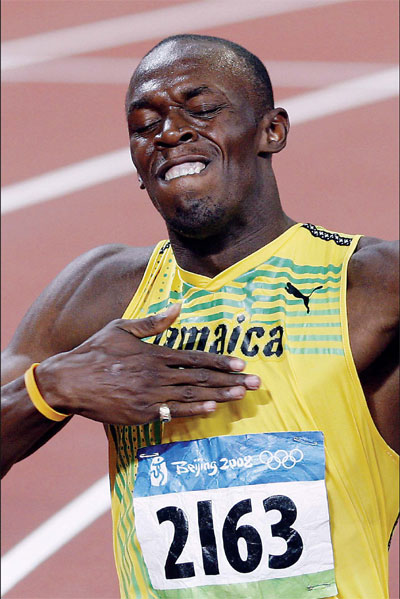
| Now ... Usain Colt! |
The perpetually poor are not blameless.
Society's efforts to curb violence and relieve poverty are for naught unless people want to change.
Anyone can find themselves in unplanned and unforeseen unfortunate circumstances.
Most people, eventually, by their own effort and/or with the help of others, overcome adversity.
Some people, however, are perpetually poor.
Why? Because they don't do the things required of them to move up and out.
With apologies to Stephen R. Covey, here are the seven habits of highly unsuccessful people.
- Mismanaging the money they have. Some low-income people find a way to save for the future, but they do so by foregoing $300 Nike shoes.;
- Believing in the quick fix. The lottery is not the ticket to the future and it would be helpful if the government didn't advertise it as such.;
- Believing life itself is a lottery. Life isn't fair, but the accident of our birth, regardless of circumstances, is no guaranteed predictor of success or failure. Successful people weather the storms, while unsuccessful people see themselves as victims, with no options.;
- Inability to manage emotions. Unsuccessful people get stuck in feelings of hopelessness, frustration and anger, letting those emotions rule them.;
- Picking the wrong role model. They let unsuccessful people school them on the ways of life, rather than seeking out people who have overcome the same challenges they face.;
- Setting low goals. The problem is that once a low goal is achieved, the person feels that is all he or she can do. Setting unrealistic goals is also harmful, but goals should always be a bit higher than what has already been accomplished.;
- Believing in wishing and hoping. Pop culture self-help programs encourage people to wish hard for success and claim it will simply happen. That is dangerous because it is appealing; something for nothing. It's like praying for success while forgetting God helps those who help themselves. Everyone has a moral responsibility to provide for themselves as much as possible.
We should approach the issue of poverty from that standpoint.
We are not tough enough in society today with those people accessing the labour of others, through taxpayer-supported social programs.
Here is a three-point program for avoiding poverty.
- Stay in school to at least obtain a high school graduation. It is free for the student, so it is not too much to ask. Perhaps we should make it more of a demand.;
- Don't have children until you are able to financially care for them. It is not too much to ask. To do otherwise is a form of child abuse. Anyone can fall on hard times, but if properly prepared before having children a person will recover for their own and their children's benefit.;
- Stay off illegal drugs and off alcohol if it causes problems in your life, according to other people. (Drunks are bad at self-analysis.) It is not too much to ask.;
Poverty is no excuse for crime, but violent crime tends to emanate from impoverished neighbourhoods.
We've spent billions on a "war on poverty" to negligible effect as there are still huge numbers of poor people.
Perhaps we should demand more from people who stay on public support for decades and for successive generations.
Sent from my BlackBerry® device from Digicel
 | |||
| Prime Minister Portia Simpson Miller shows appreciation after unveiling a statue of Mahatma Gandhi in the Inspiration Garden of the Faculty of Education and Humanities at the University of the West Indies, Mona. The statue is a gift from the people of India. Speaking at the unveiling, Minister of Foreign Affairs Senator A J Nicholson said that the presence of the statue will help to foster appreciation for the university’s motto “a light shining from the West” on the campus, and foster deeper thinking among students about the teachings of non-violence that were promoted by Gandhi.- Observer photo |



 7. When Ernie Smith sang, "Quarrie was a boy to I man last night" in his classic hit Duppy or Gunman,
Donald Quarrie (DQ) was immortalised and was forever part of Jamaican
folklore. He is, arguably, before Bolt, the most universally respected
Jamaican sprinter ever.
7. When Ernie Smith sang, "Quarrie was a boy to I man last night" in his classic hit Duppy or Gunman,
Donald Quarrie (DQ) was immortalised and was forever part of Jamaican
folklore. He is, arguably, before Bolt, the most universally respected
Jamaican sprinter ever.

 Michael is still revered as being among the very best commentators in the game and his contribution to the sport continues.
  |
| Nelson Mandela |
 |
| Grantees of the PROComm-Stella Maris Foundation Scholarship Fund had a great time a a lunch hosted by the PROComm Team at Caribbean Cottage, Kingsway in honour of Mandela Day. From left are: Akeem Luke (New Day Junior High), Vanessa Gaynor (Mona High), Ashanti Hall (New Day Primary), Orlando Reid and Kemar Carter (Shortwood Practising) and Sashwana Chance (Meadowbrook High) |
 |
| PM Most Hon Portia Simpson Miller (centre, in red) and Her Excellency Mathu Joyini, High Commissioner for South Africa with the Simply Chrisolites group and other guests at the Mandela Day press launch last Wednesday at the Prime Minister's Office |
Local journalists headed to London to cover the Olympic Games are confident that Jamaica will reap at least 11 medals but they are coy about the colours.
At a Press Association of Jamaica (PAJ) arranged send off on Tuesday July 17, for journalists covering the Games, the predictions ranged from a high of 14 medals to a low of 10.
Veteran journalist Clare Forrester who will be covering her fourth Olympic Games was most gung-ho as she predicted that, barring injuries, the Jamaicans should return with 14 medals.
CVM's Wayne Walker, whose post cards from Beijing were a huge hit during the 2008 Olympic Games, was confident that Jamaica will, at least, repeat its 11-medal haul and he would not be surprised if there was another medal added to the list.
The Gleaner's Andre Lowe, who is quickly developing a reputation as one of the region's top track and field reporters agreed that 11 medals should be in the bag when the Games are completed but he also played it safe as to the colour.
Kayon Raynor, who was outstanding writing for the Jamaica Observer from Beijing, will be doing the job for the RJR Communication Group this time around and he expects that there will be one more medal to report on.
Based on Raynor's projection it should be a ten medal haul but the man who will be shooting the videos for him, veteran videographer Oral Napier is confident that it will be 13.
While members of the Jamaica Observer's team, Paul Reid and Bryan Cummings, missed the send-off because they are already in Britain, their editor Ian Burnett expressed confidence that the team will garner 11 medals.
Burnett is more respected for his knowledge of football, cricket and horse racing so his predictions were greeted with some skepticism but his general sporting back-ground meant that he was taken more seriously than the Gleaner's Darraine Luton who projected 10 medals.
Others journalists not known for any connection with sports such as Radio Jamaica's Rohan Powell and Karen Madden-James, probably emboldened by the presence of the outstanding sports reporters, added their projections to the list.
Madden-James declared that the athletes will come home with 12 medals while Powell argued that a repeat of the Beijing 11-medal haul is on the cards.
Most of the journalists headed to London will jet off by the end of this week and the PAJ is confident that the public will be well served over the radio, television, print and Internet as Jamaican athletes go for glory in the Olympic Games.
Arthur Hall
Public Relations Director
Press Association of Jamaica
Sent from my BlackBerry® device from Digicel
 | |

 |
| Shelly-Ann Fraser Pryce
shows off her Jamaican flag
to the world. |


